Episodes in Computing History#
Note
This chapter is still very preliminary and is not intended to be exhaustive. It is based primarily on the author’s own published works:
George K. Thiruvathukal, “Episodes in Computing History — Salon Talk,” Loyola University Chicago, 2025. ecommons.luc.edu/cs_facpubs/417 (doi:10.6084/m9.figshare.29632070) — primary source.
George K. Thiruvathukal and David B. Dennis, “Computer Science and Cultural History: A Dialogue,” CESTEMER Conference, Goodman Theater, Chicago, September 2017. ecommons.luc.edu/history_facpubs/42
George K. Thiruvathukal, “Artificial Intelligence and/or Machine Learning (AI &| ML),” Invited Panel Discussion, Loyola University Retiree Association (LUCRA), March 2024. ecommons.luc.edu/cs_facpubs/378 (doi:10.6084/m9.figshare.25955026)
George K. Thiruvathukal, Editor in Chief, Computing in Science and Engineering (IEEE/AIP), 2013–2016. A mini-history of computing was among the editorial projects completed during this tenure.
The story of computing does not begin with electricity, transistors, or programming languages. It begins with the far older and more fundamental human obsession with counting, calculating, and communicating. This chapter traces that story — from the first scratches on bone to the stored-program computer — as a series of episodes, each one building on what came before.
Numbers and Calculation#
Tally Sticks and Early Counting#
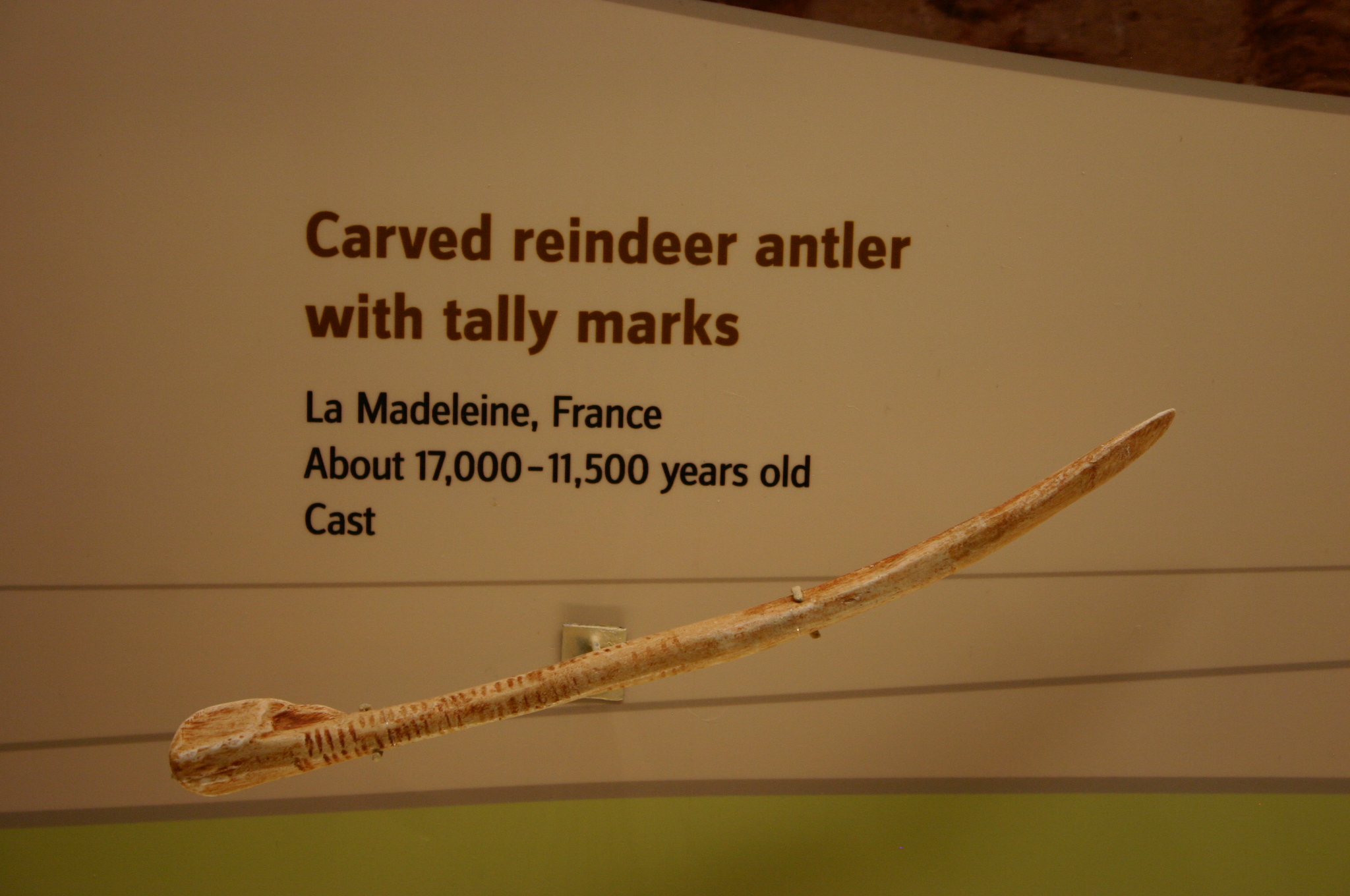
A carved reindeer antler with tally marks from La Madeleine, France (c. 15,000–11,500 BCE) — one of humanity’s earliest known recording devices, predating writing by thousands of years. Source: Ryan Somma / Wikimedia Commons, CC BY-SA 2.0.#
.jpg)
Around 4000 BCE, traders in the Mesopotamian city of Uruk made a remarkable discovery: the same number could stand for ten sheep, ten bags of grain, or ten talents of copper. The quantity and the thing being counted were separable. That abstraction — number as an independent concept — is the foundation of everything that follows.
By about 3000 BCE, Egyptian tallies grouped items in tens, then regrouped at a hundred, and again at a thousand. The tally stick, a notched piece of bone or wood, was one of humanity’s earliest recording devices. Versions of it were used continuously across cultures for millennia, and Roman numerals are thought by some scholars to have descended directly from tally-stick notches: the X for ten, for instance, originated as a tally mark of four strokes crossed by a diagonal, and one half of that X became the V for five. The word calculus itself is Latin for a small stone used in reckoning — the pebbles people once moved across counting boards to track quantities.
Hieroglyphic Numbers and Pictographic Systems#
The Egyptians went further, devising a pictographic system in use from roughly 3200 BCE to 400 CE. Each power of ten received its own symbol: a vertical stick for one, an arch for ten, a coiled rope for a hundred, a lotus flower for a thousand, a finger pointing skyward for ten thousand, a tadpole drawn from the Nile for a hundred thousand, and a man with arms raised to heaven for a million. The system was expressive but cumbersome — to write 999 you needed twenty-seven separate signs — and it had no symbol for zero.
Roman Numerals#
The Romans adapted and extended the tally tradition. Their numerals are alphabetical in appearance but did not originate that way: early artifacts show that the symbol for ten was a crossed tally mark, not a letter. Roman numerals are notable above all for what they lack: zero. Without a placeholder for an unused position, calculation is laborious. Try multiplying XLVII by MCXIII and the limitation becomes immediately apparent.
The Greeks adapted their alphabet for numerals, and the Romans followed with their own alphabetical-looking symbols. But it was a tradition far to the east that would supply the missing ingredient.
The House of Wisdom and Al-Khowarizmi#

Statue of Muhammad ibn Musa al-Khwarizmi in Urgench, Uzbekistan — the mathematician whose Latinized name gave us the word algorithm. Source: Adam Harangozó / Wikimedia Commons, CC BY-SA 4.0.#

In 800 CE, Caliph Al-Mamun established Bayt al-Hikmah — the House of Wisdom — in Baghdad. Scholars were dispatched to translate the accumulated scientific knowledge of Greece, preserved in the libraries of Constantinople, into Arabic. This transmission of ancient learning set the stage for an extraordinary flowering of mathematics and science.
Among the scholars working in this tradition was Abu Jafar Mohammed Ibn Musa Al-Khowarizmi, born around 780 CE in Khiva (present-day Uzbekistan). His Algebra was the first systematic treatment of the solution of linear and quadratic equations — earning him the title father of algebra. He used the Hindu numeral system and the decimal place-value system, and his work spread throughout Europe via Arab traders. Two words in everyday use today carry his memory: algorithm derives from the Latinization of his name, and algebra from the title of his book, Al-Jabr.
Hindu-Arabic Notation and the Gift of Zero#
The numeral system that Al-Khowarizmi used originated in India. Indian mathematicians used horizontal tallies for one, two, and three, and special symbols for four through nine. Around 600 CE they introduced place value: rather than writing the equivalent of 100 + 80 + 7, they simply wrote 187, with the position of each digit encoding its magnitude. Nine digits plus a symbol for zero — probably derived from astronomers’ practice of marking empty positions — was sufficient to represent any number.
The oldest undisputed written zero appears in a stone inscription dated 876 CE at the Chaturbhuj Temple in Madhya Pradesh, India. Arab traders carried the system west, where it became known simply as Arabic numerals. This system, combined with George Boole’s boolean logic of 1854 — which reduced all logical reasoning to true and false, one and zero — provides the complete mathematical foundation for every computer ever built.
The Mesopotamians and Base Sixty#
Not all ancient number systems were base ten. The Mesopotamians, around 3000 BCE, used a system based on sixty — the sexagesimal system. Astronomers found it extraordinarily useful because sixty has many factors, making division clean. Its influence endures invisibly in modern life: sixty seconds in a minute, sixty minutes in an hour, and 360 degrees in a full circle all descend directly from Mesopotamian counting practice. Ptolemy’s Almagest, the great mathematical and astronomical treatise of the second century CE, drew on this system throughout.
Nascent Computing Attempts#
The Quipu of the Inca Empire#
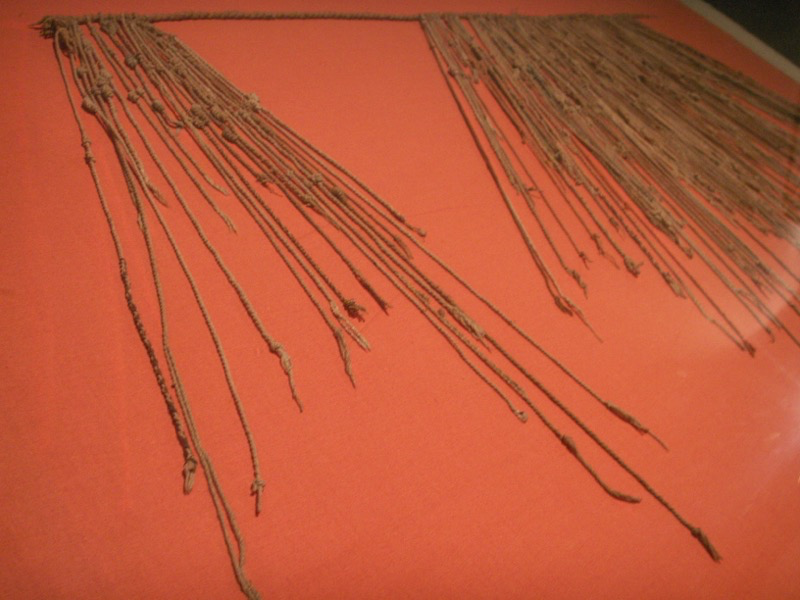
A quipu — knotted, colored cords used by the Inca Empire for census records, tax accounting, and long-distance communication. Source: Jorge Mori / Wikimedia Commons, Public Domain (CC0).#

Across the Atlantic, the Inca Empire and its predecessors developed a completely different recording technology. The quipu (also spelled khipu) consisted of colored, spun, and plied threads of llama or alpaca hair, or cotton cord, with numeric and other values encoded by knots tied in a base-ten positional system. Quipus were used for census counts, tax accounting, and record-keeping across a vast empire. They are a vivid reminder that information encoding admits many physical forms.
The Abacus#
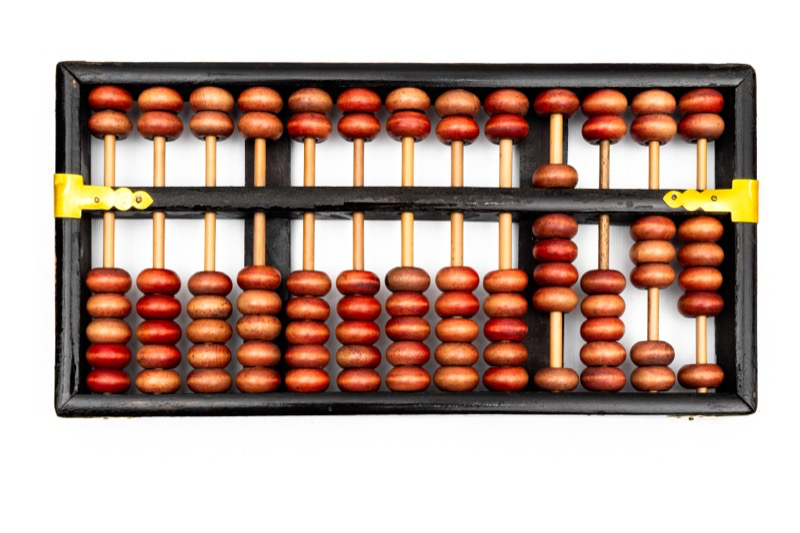
A Chinese suanpan abacus — the primary calculation aid across Asia and the Mediterranean for millennia. This example encodes the number 9,034. Source: Felix Winkelnkemper / Wikimedia Commons, CC BY-SA 4.0.#

The abacus, an early form of beads on wires, appeared in China around 3000 BCE. Its name derives from the Semitic word abaq, meaning dust — an allusion to the counting boards of antiquity on which pebbles or sand could be moved to track calculations. For millennia the abacus was the primary calculation aid across Asia and the Mediterranean, and skilled users could perform arithmetic at remarkable speed.
Finger Reckoning#
Before the abacus, and long alongside it, humans reckoned on their fingers. The word digit preserves this history: it comes from the Latin digitus, meaning finger or toe, and its numerical sense arose because numerals under ten were counted on fingers. Medieval practitioners of finger reckoning could represent numbers up to nine thousand using elaborate configurations of both hands. Educated people memorized multiplication tables up to five times five; for larger products they used systematic finger configurations and addition to derive the rest.
Napier’s Bones and the Slide Rule#
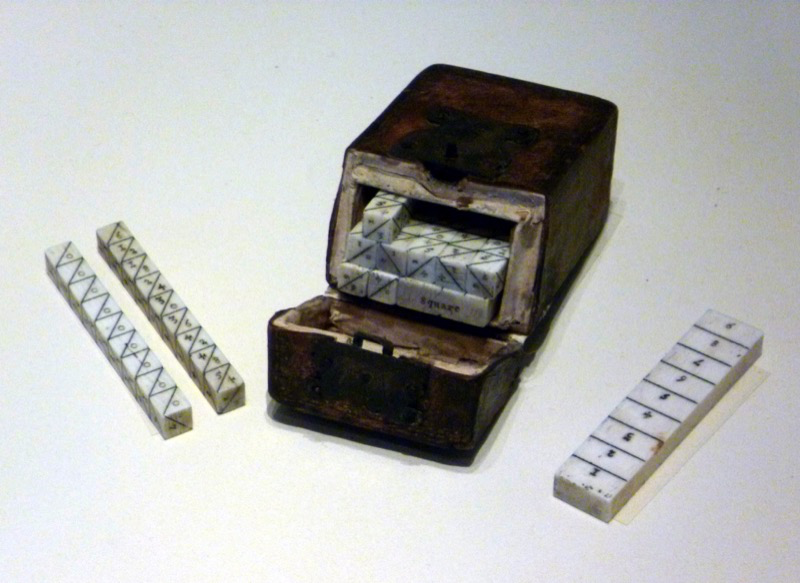
Napier’s Bones (c. 1650, ivory) at the National Museum of Scotland — numbered rods that reduced multiplication to reading diagonal sums. Source: Kim Traynor / Wikimedia Commons, CC BY-SA 3.0.#

By the seventeenth century the tools of calculation were becoming more sophisticated. John Napier (1550–1617), best known for inventing logarithms, also devised a set of numbered rods — Napier’s Bones — that reduced multiplication to the much simpler operation of reading diagonal sums. His Rabdologia of 1617 described the method in detail. Wilhelm Schickard (1592–1635) took Napier’s bones a step further, mounting them on cylinders with gears and a carry mechanism to build one of the earliest mechanical calculators, though no original example survives.
Napier’s logarithms also gave rise to the slide rule. Edmund Gunter created his Line of Numbers in 1620; William Oughtred (c. 1574–1660) then placed two such scales alongside each other, producing the circular slide rule in 1622 and the familiar linear form shortly after. Engineers relied on the slide rule for precise calculation until pocket electronic calculators arrived in the 1970s.
Blaise Pascal’s Pascaline#
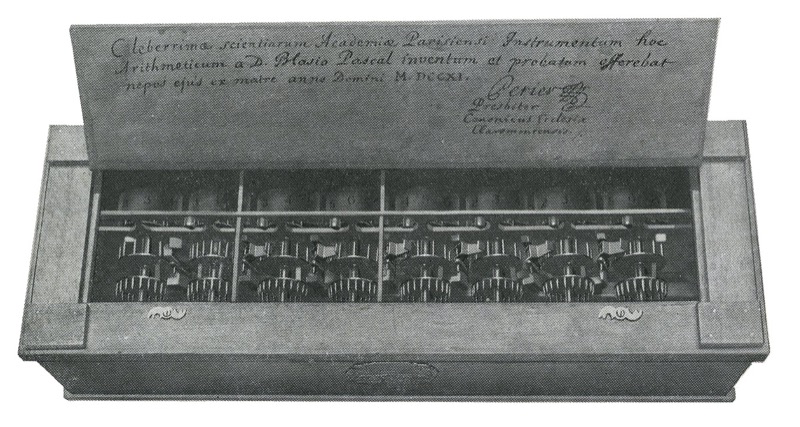
The Pascaline (c. 1642) — Pascal’s eight-digit mechanical adder. Its carry mechanism introduced the principle of complement arithmetic still used in modern CPUs. Source: J. A. V. Turck, Origin of Modern Calculating Machines, 1921 / Wikimedia Commons, Public Domain.#

Blaise Pascal built his Pascaline around 1642, at the age of nineteen, to help his father — a tax collector in Rouen — manage the tedious arithmetic of his work. The machine used interlocking gear wheels with a carry mechanism to add numbers up to eight digits. Pascal eventually built fifty Pascalines. The device introduced a principle still central to modern computers: subtraction performed by adding the nine’s complement of the subtrahend. What looks like subtraction is actually addition with a cleverly disguised operand — a technique computers use to this day in the form of two’s complement arithmetic.
Leibniz’s Stepped Drum Calculator#
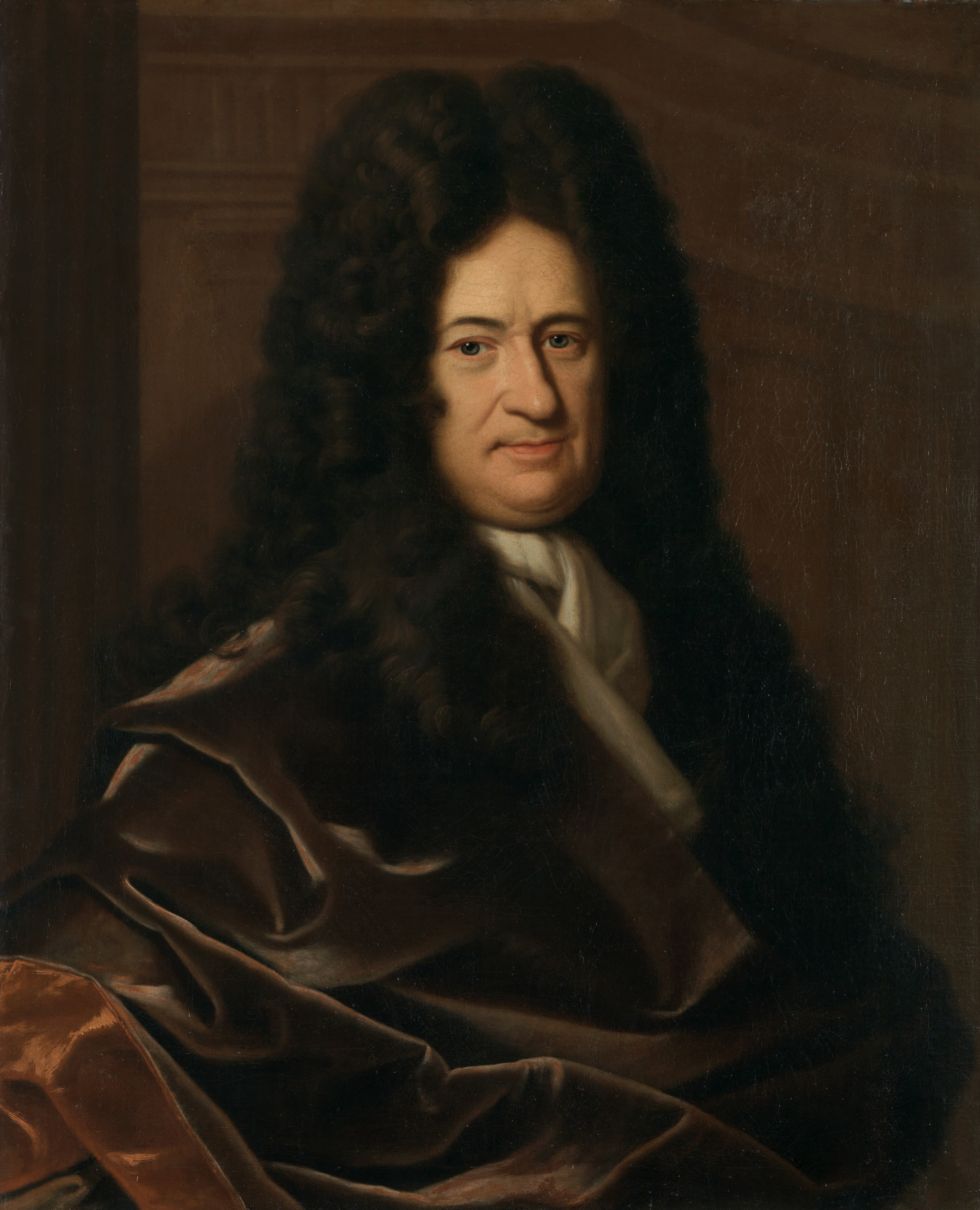
Gottfried Wilhelm Leibniz (c. 1695), mathematician and inventor of the Stepped Drum Calculator. Source: Christoph Bernhard Francke / Wikimedia Commons, Public Domain.#
.jpg)
Gottfried Wilhelm Leibniz extended Pascal’s design with the Stepped Drum Calculator, which could perform not just addition but multiplication and division through repeated additions. The stepped drum — a cylinder with teeth of varying lengths — became the basis of mechanical calculators for the next two centuries.
Communications and the Information Age#
Homing Pigeons#
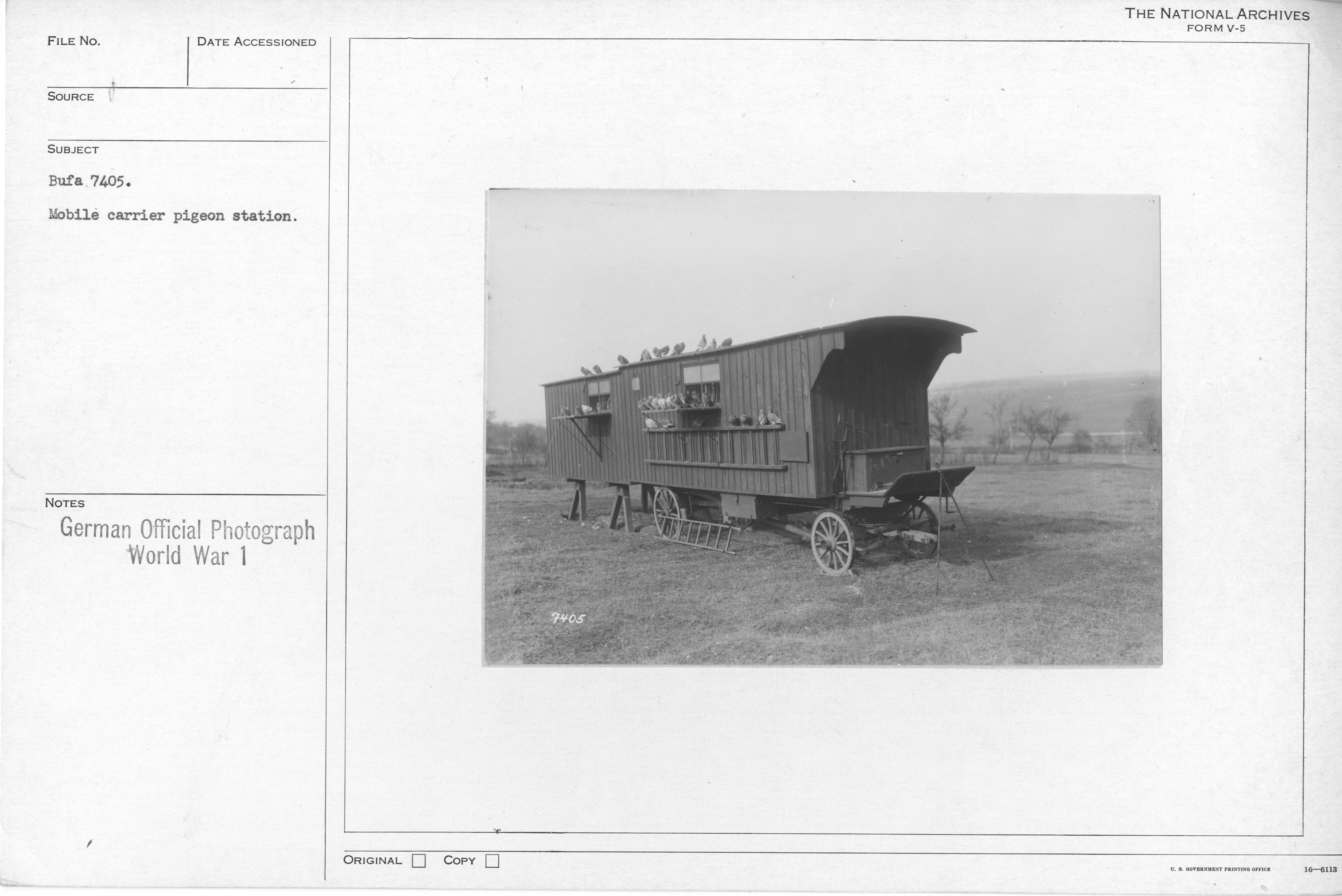
A mobile carrier pigeon station, Western Front, c. 1917–1918 — pigeons remained a critical long-range communication technology through both World Wars. Source: U.S. War Department / Wikimedia Commons, Public Domain (NARA).#

Calculating is only half the problem; the other half is communicating results across distance. Persian trainers pioneered the use of homing pigeons for long-range message delivery. The Greeks used pigeons to carry the names of Olympic victors to their home cities. Pigeons were still in active military use during the Siege of Paris in 1870–71 and were officially discontinued as a communication technology only around 1910.
Samuel Morse and the Telegraph#
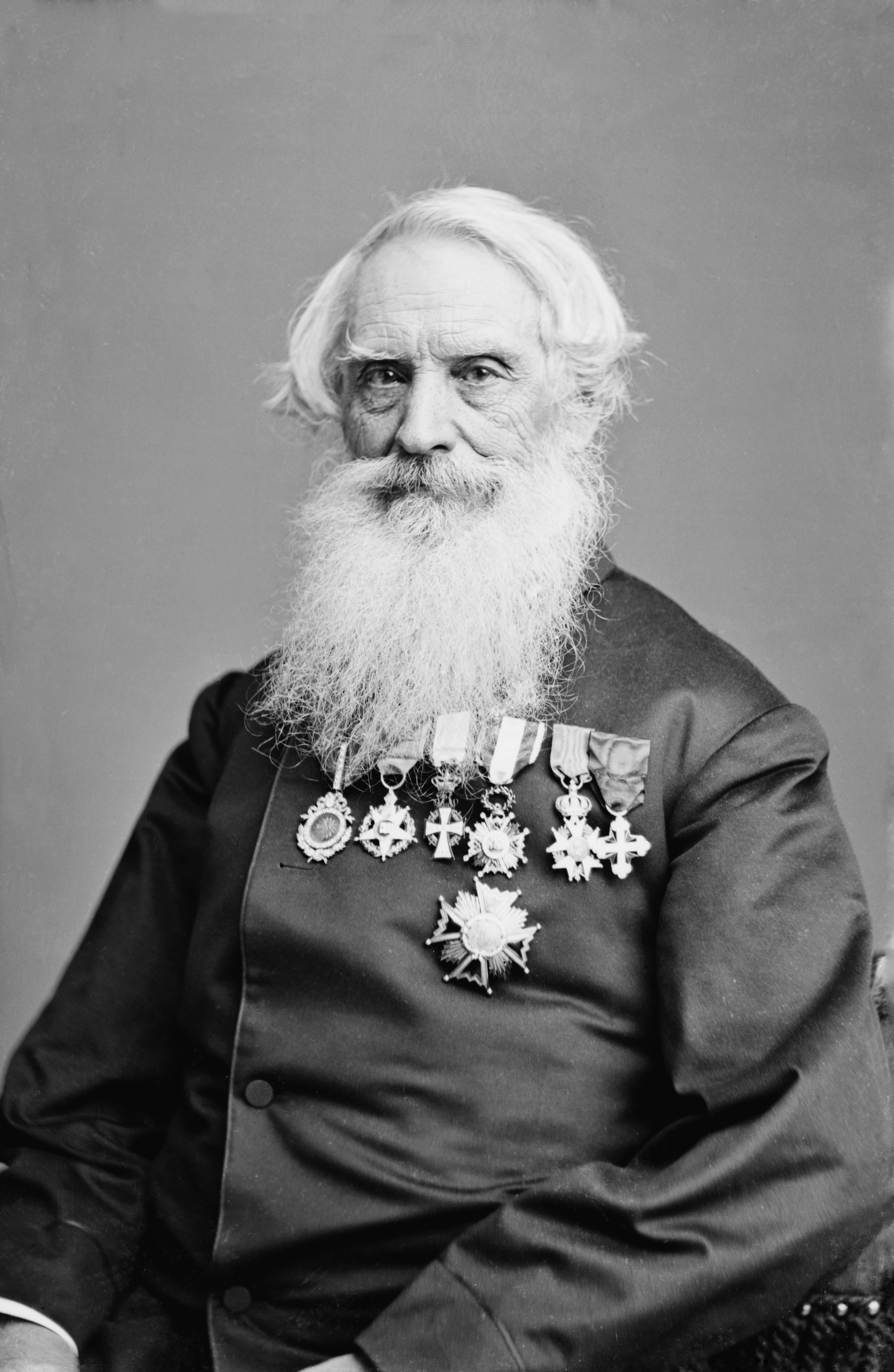
Samuel F.B. Morse (c. 1855–1865) — painter turned inventor whose telegraph and dot-dash code transformed long-distance communication. Source: Mathew Brady / Wikimedia Commons, Public Domain.#


The International Morse Code — dots and dashes assigned to each letter and digit, with common letters receiving the shortest sequences. Source: Rhey T. Snodgrass & Victor F. Camp (1922) / Wikimedia Commons, Public Domain.#

Samuel F.B. Morse (1791–1872) began his career as a painter — a Yale graduate who moved to New York in 1823 and became one of the foremost American artists of his day. A chance shipboard conversation about electromagnetism in 1832 redirected his life. Morse reasoned that if electricity could be made visible at any point in a circuit, intelligence could be transmitted instantaneously to any distance. He was right. His telegraph, patched together from an artist’s canvas frame and salvaged hardware, sent its first long-distance message in 1844.
The code Morse devised assigned sequences of dots and dashes to each letter, with common letters receiving shorter codes. Its impact was immediate and transformative. By 1846 the telegraph was coordinating reports of the Mexican War. In 1848 six New York newspapers pooled their telegraph costs to form what became the Associated Press. By the 1850s the Erie Railroad was using it to manage tracks, switches, freight, and personnel across a dispersed enterprise — foreshadowing what we now call networked information systems. In 1858 the first transatlantic cable was laid, though it took twenty-six hours for the first message to cross; a more reliable cable followed in 1866. By 1864 telegraph intelligence gave the Union Army a decisive advantage in the Civil War.
Looms and Mechanical Computing#
The Jacquard Loom#
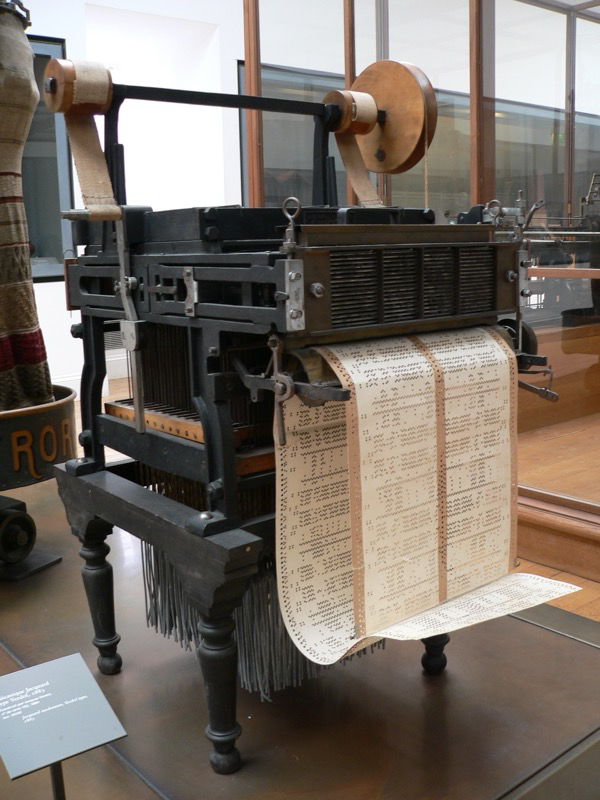
A Jacquard loom (c. 1804) at the Musée des Arts et Métiers, Paris. The chain of punched cards at top encodes the weaving pattern — effectively a program. Source: David Monniaux / Wikimedia Commons, CC BY-SA 3.0.#

In 1804, the French silk weaver Joseph Marie Jacquard introduced a loom controlled by chains of punched cards. Each card encoded one row of a woven pattern: a hole in a given position allowed a hook to pass through and raise the corresponding warp thread; a solid position blocked the hook. The sequence of cards constituted, in effect, a program. The connection to computing was not lost on later inventors: Babbage explicitly acknowledged the Jacquard loom as an inspiration for his Analytical Engine, and Herman Hollerith’s punched cards for the 1890 census carried the same principle into data processing.
Charles Babbage and Ada Lovelace#
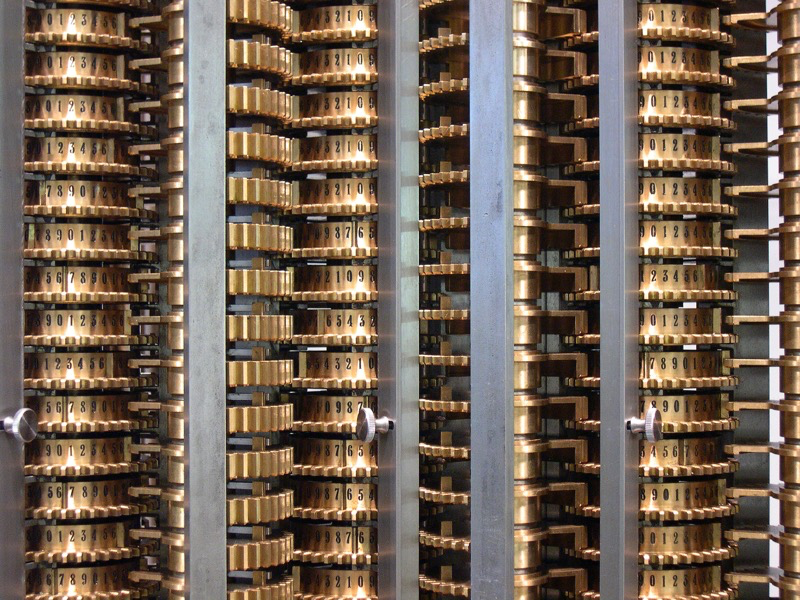
Babbage’s Difference Engine No. 2 — the Science Museum London’s 1991 reconstruction, built from Babbage’s original drawings. It computed correctly to 31 digits on the first try. Source: Carsten Ullrich / Wikimedia Commons, CC BY-SA 2.5.#

Charles Babbage designed two mechanical computing engines of extraordinary ambition. The Difference Engine, designed in the 1820s, was intended to compute and print mathematical tables automatically, eliminating the errors that human computers introduced when calculating logarithm and trigonometry tables by hand. A working Difference Engine was not actually constructed until 1991, when the Science Museum in London built one from Babbage’s original drawings and found that it worked correctly to 31 digits.
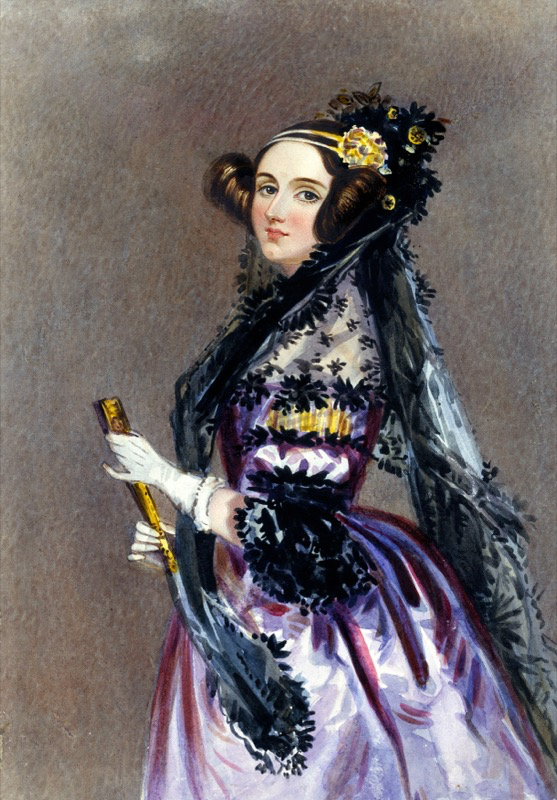
Ada Lovelace (c. 1840), painted by Alfred Edward Chalon. Her annotated translation of Menabrea’s account of the Analytical Engine is recognized as the first algorithm intended for machine execution. Source: Alfred Edward Chalon / Wikimedia Commons, Public Domain.#

Babbage’s more ambitious Analytical Engine went further still: it was designed to be programmable, with a separate store (memory), a mill (processor), input via punched cards, and printed output. Ada Lovelace, who translated an Italian engineer’s account of the Analytical Engine and added notes longer than the original text, is credited with writing what is recognized as the first algorithm intended for machine execution. The Ada programming language, used today in safety-critical systems, is named in her honor.
Herman Hollerith and the 1890 Census#
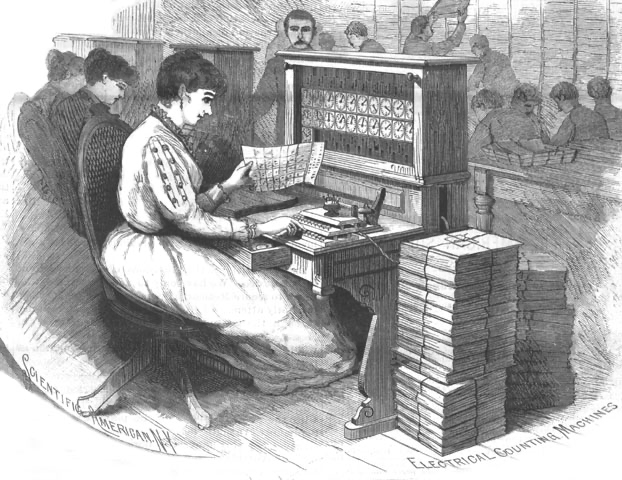
Hollerith’s electrical tabulating machines in operation, as illustrated in Scientific American, August 30, 1890. His company eventually became IBM. Source: Uncredited illustrator / Wikimedia Commons, Public Domain.#

By 1880 the United States Census Bureau faced a crisis: it had taken nearly a decade to tabulate the previous census by hand, and the 1890 population would be even larger. Herman Hollerith, a statistician, devised a system of punched cards and electromechanical tabulating machines that reduced the count to a matter of weeks. The holes in each card were sensed by pins that dipped into mercury, completing electrical circuits that advanced counters. Hollerith’s company eventually became part of IBM. The punched card he invented remained a primary medium for data entry into computers well into the 1970s.
Early Electronic Computing#
The Atanasoff-Berry Computer#
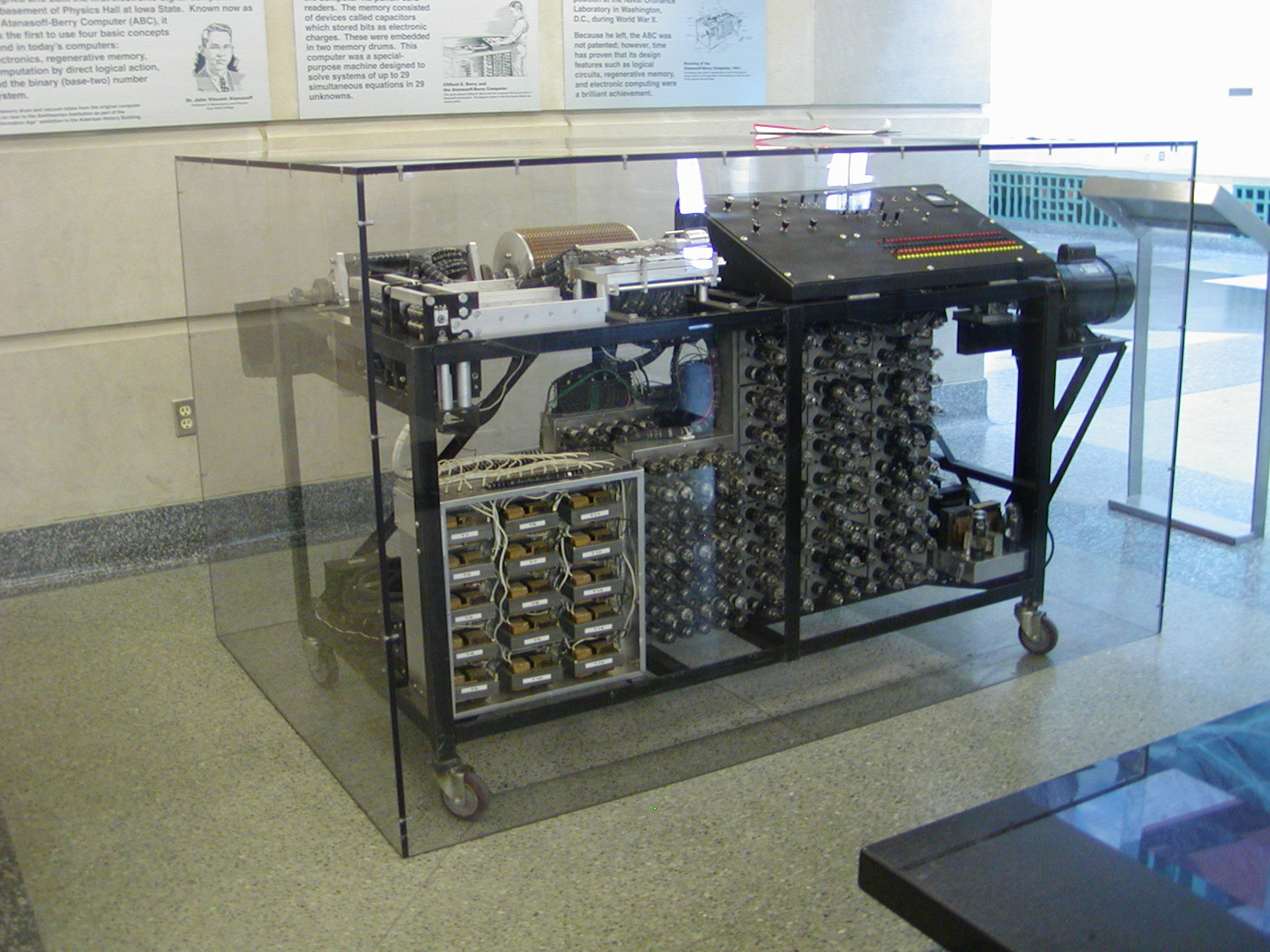
Reconstruction of the Atanasoff-Berry Computer (ABC) at Iowa State University’s Durham Center — the first electronic digital computing device, built between 1937 and 1942. Source: Manop / Wikimedia Commons, CC BY-SA 3.0.#

Before the better-known wartime machines, John Vincent Atanasoff and his graduate student Clifford Berry built the first electronic digital computing device at Iowa State College between 1937 and 1942. The Atanasoff-Berry Computer (ABC) was not programmable in the modern sense. However, its ability to focus on simultaneous linear equations strongly implies the ability to perform general arithmetic and logic, and it certainly pioneered many ideas — including the use of binary arithmetic (which was notably absent from the later ENIAC) and the use of electronic switches (vacuum tubes) rather than mechanical gears to perform calculation. The ABC also introduced regenerative capacitor memory to hold intermediate results. Although the machine was never fully completed and was largely forgotten for decades, a landmark 1973 U.S. federal court ruling invalidated the ENIAC patent and recognized Atanasoff as the originator of several foundational computing concepts.
Konrad Zuse and the Z3#
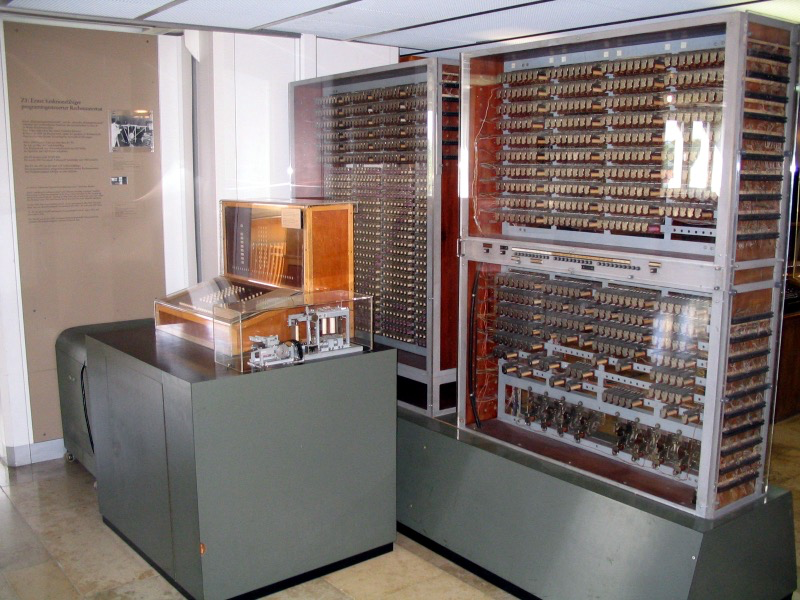
Reconstruction of Konrad Zuse’s Z3 (1941) at the Deutsches Museum, Munich — the first Turing-complete programmable computer. The original was destroyed in a 1943 Allied bombing raid. Source: Venusianer / Wikimedia Commons, CC BY-SA 3.0.#

The German engineer Konrad Zuse built the Z3 in 1941 — the first Turing-complete programmable computer. It used binary arithmetic and was programmed via punched film tape. Zuse worked largely in isolation, unaware of parallel developments in Britain and the United States. The Z3 was destroyed in a 1943 Allied bombing raid; a reconstruction now stands in the Deutsches Museum in Munich.
Colossus at Bletchley Park#
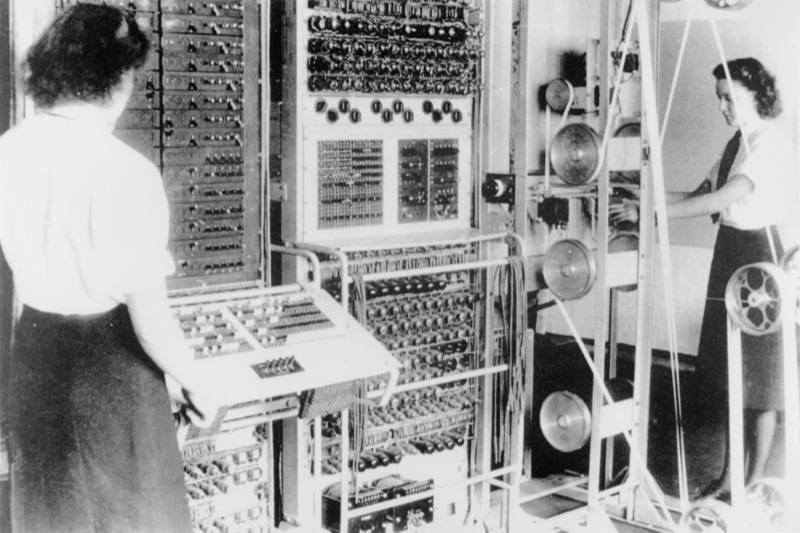
Colossus (1944) at Bletchley Park — the world’s first electronic, digital, programmable computer. Its existence was classified until the 1970s. Source: The National Archives (UK), ref. FO850/234 / Wikimedia Commons, Public Domain.#

In Britain, the urgent need to break German military codes drove the development of Colossus — the world’s first electronic, digital, programmable computer, built at Bletchley Park and operational by 1944. Colossus was designed to crack messages encrypted by the Lorenz machine, the cipher teleprinter used by the German High Command. Its existence was kept secret until the 1970s, which obscured its place in computing history for decades.
ENIAC and the Women Who Programmed It#
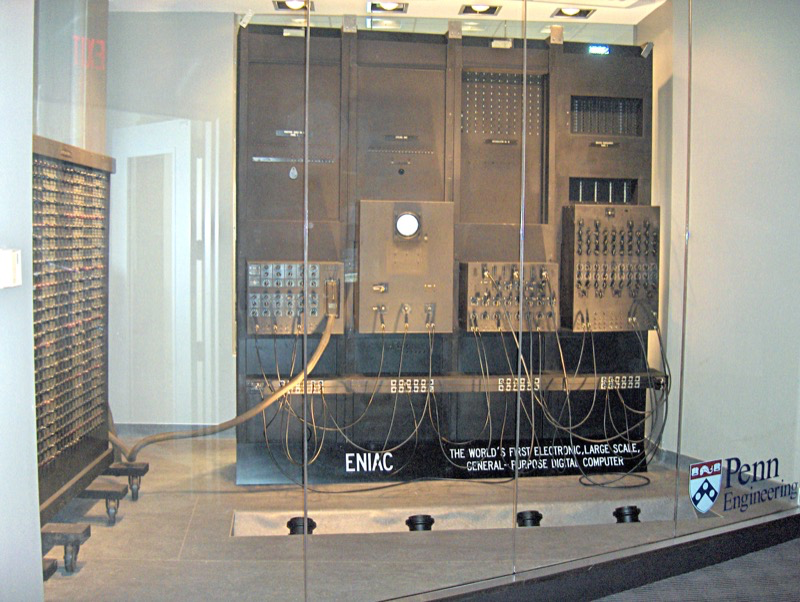
ENIAC (1945) on display at the University of Pennsylvania — the room-filling machine that could perform thousands of arithmetic operations per second. Source: Paul W. Shaffer / Wikimedia Commons, CC BY-SA 3.0.#

The ENIAC — Electronic Numerical Integrator and Computer — was built at the University of Pennsylvania by J. Presper Eckert and John Mauchly and became operational in 1945. Filling a room and consuming 150 kilowatts of power, it could perform thousands of arithmetic operations per second, far faster than any mechanical device.
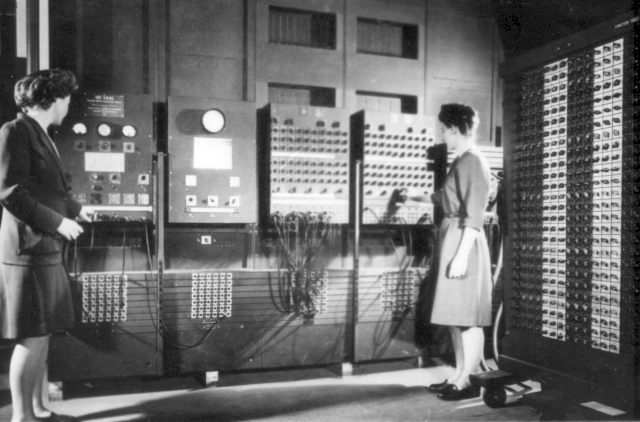
Betty Jennings (left, later Jean Bartik) and Frances Bilas (right, later Frances Spence) at the ENIAC main control panel, Moore School of Engineering, c. 1945–1947. Source: United States Army / Wikimedia Commons, Public Domain.#

What is less often celebrated is that the programming and wiring of computations on the ENIAC was carried out by six women: Jean Jennings, Frances Bilas, Betty Holberton, Ruth Lichterman, Kathleen McNulty, and Marlyn Wescoff. Working from mathematical problem descriptions and wiring diagrams, they developed the techniques of programming as we understand them today.
UNIVAC and the 1952 Election#
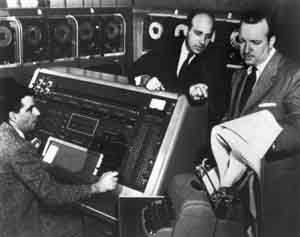
UNIVAC I on election night, November 4, 1952 — with Walter Cronkite (center) and engineers J. Presper Eckert and Harold Sweeny. The machine correctly predicted an Eisenhower landslide that CBS initially refused to air. Source: U.S. Census Bureau / Wikimedia Commons, Public Domain.#

The UNIVAC II, the commercial successor to the ENIAC era, entered public consciousness in a striking way: CBS used it to predict the outcome of the 1952 presidential election. The machine’s projection of an Eisenhower landslide — based on early returns — was so at odds with conventional wisdom that CBS initially declined to broadcast it. The machine was right.
“As We May Think” and the World Wide Web#
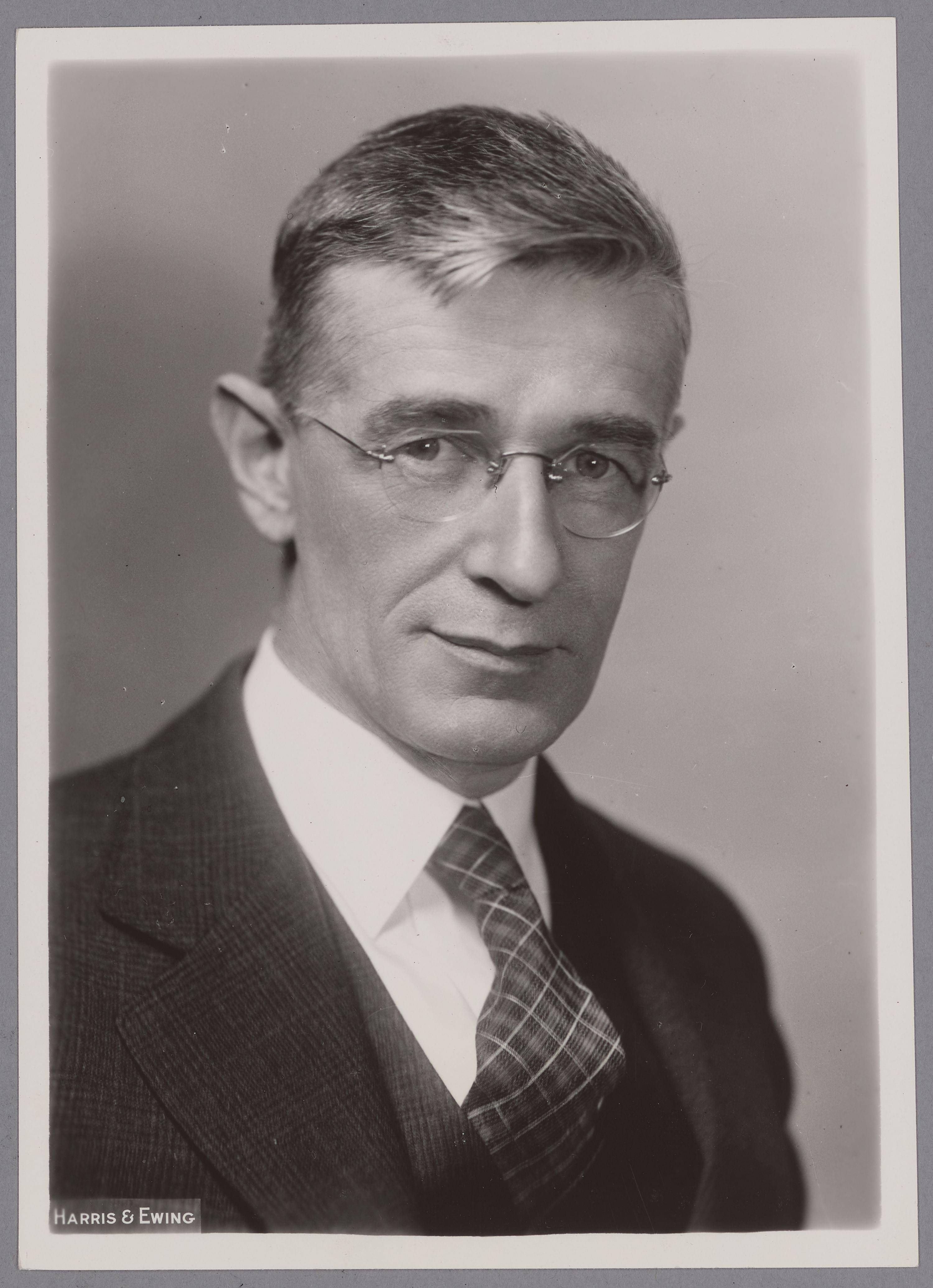
Vannevar Bush (1938), Director of the Office of Scientific Research and Development — whose 1945 essay “As We May Think” envisioned the memex, a precursor to the World Wide Web. Source: Harris & Ewing / Wikimedia Commons, Public Domain.#

While engineers were building the first electronic machines, a visionary government scientist named Vannevar Bush was looking further ahead. In a landmark 1945 essay in The Atlantic Monthly, titled “As We May Think,” Bush described a hypothetical device he called the memex — short for memory extender. Bush was Director of the Office of Scientific Research and Development (the precursor to NSF and ARPA) and had coordinated the United States’ vast wartime scientific effort. He worried that humanity’s store of knowledge had grown so large that no individual could find what was relevant to their work, and he proposed a solution:
Consider a future device for individual use, which is a sort of mechanized private file and library… A memex is a device in which an individual stores all his books, records, and communications, and which is mechanized so that it may be consulted with exceeding speed and flexibility.
The memex would allow users to link related records together, creating personal trails of association through accumulated knowledge. Bush’s vision looks remarkably like the World Wide Web: a device through which documents are linked, searched, and traversed at will. Decades of work on hypertext and networked computing were required to realize it, and Bush himself believed that much of his vision remained unachieved even late in his life.
Stored Program and Universal Computing#
The Universal Turing Machine#
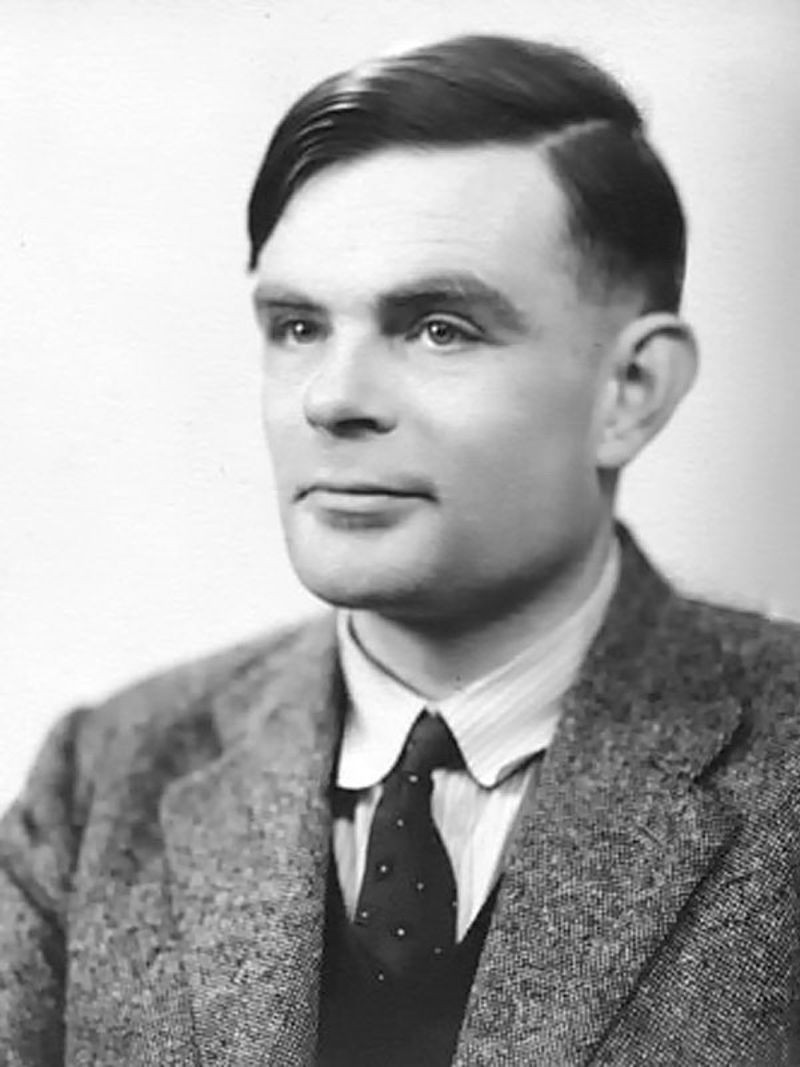
Alan Turing (1912–1954), photographed in 1951 by Elliott & Fry. His 1936 paper created theoretical computer science before electronic computers existed. Source: Elliott & Fry / Wikimedia Commons, Public Domain.#
.jpg)
In 1936, a young Cambridge mathematician named Alan Turing published a paper that created theoretical computer science before electronic computers existed. Turing proposed an abstract machine — now called the Turing machine — consisting of an infinite tape divided into cells, a read/write head that could move one cell at a time, and a finite table of instructions. The machine could be made to simulate any other such machine by loading the appropriate instructions onto its tape: hence the universal Turing machine.
Every programming language in use today, including Python, is Turing-equivalent: any computation that a Turing machine can perform, they can perform, and vice versa. Turing also contributed directly to the war effort — his work at Bletchley Park on breaking the Enigma cipher is credited with significantly shortening the conflict. Despite this, he was prosecuted in 1952 for his homosexuality, subjected to chemical castration, and died in 1954. He was posthumously pardoned by the British government in 2013 and granted a statutory pardon in 2017.
John von Neumann and the Architecture of Modern Computers#
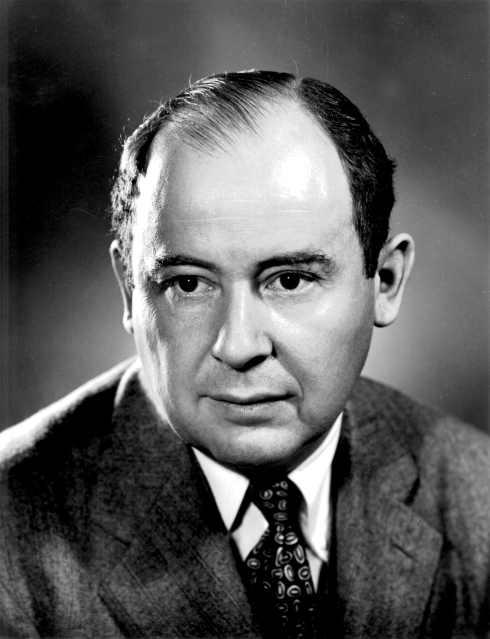
John von Neumann at Los Alamos, c. 1940s. His 1945 EDVAC report described the arithmetic unit, control unit, and memory architecture that every computer still uses today. Source: Los Alamos National Laboratory / Wikimedia Commons, Public Domain.#

While Turing provided the theoretical foundation, John von Neumann provided the architectural blueprint. Von Neumann was a polymath of extraordinary range — contributing to mathematics, physics, game theory, and economics — and was involved in the Manhattan Project before turning his attention to computing. In 1945 he circulated a draft report on the EDVAC (the successor to the ENIAC) that articulated three ideas that have shaped every computer built since:
First, the device must perform the elementary operations of arithmetic. Second, the logical control of the device is the proper sequencing of its operations by a control organ. Third, any device intended to carry out long and complicated sequences of operations must have a considerable memory.
These three elements — arithmetic unit, control unit, and memory — constitute what we call the von Neumann architecture. The machine you are reading this on, regardless of its physical form, is a realization of this architecture. The stored-program concept — the idea that instructions and data can live in the same memory, allowing the machine to treat its own program as data and modify it — turned a specialized calculator into a general-purpose tool.
Further Reading#
The following works informed this chapter and are recommended for anyone who wishes to explore computing history further.
Vanevar Bush, “As We May Think,” The Atlantic Monthly, July 1945.
Paul E. Ceruzzi, A History of Modern Computing, 2nd Edition.
Gareth Cook, “Untangling the Mystery of the Inca,” Wired, January 2007.
Gerald Holzmann and Björn Pehrson, The Early History of Data Networks.
Georges Ifrah, Universal History of Computing: From Abacus to Quantum Computer.
Howard Rheingold, Tools for Thought: The History and Future of Mind-Expanding Technology.
Simon Singh, The Code Book: The Science of Secrecy from Ancient Egypt to Quantum Cryptography.
Thomas J. Bergin, American University Computing History Museum.